Sunday, January 29, 2012

What I learned from Simon Sinek: To inspire is greater than gaining Alpha status


What I learned from Simon Sinek: To inspire is greater than gaining Alpha status

Most people believe that that when it comes to leadership and how you can be an influencer at the workplace, it’s either you need you need to be an “Alpha Male” or an “Alpha Geek” and other types of Alphas so others will follow you. 
We need to change this mindset.  Being the leader of the pack does not necessarily require gaining Alpha status. Let’s put this concept in a geek’s perspective. 
If you are behind the service desk, specifically the technical support department, others look up to you if you are the Alpha Geek; the person who knows almost every technical detail about the product or the service your company is offering.  You are the go to guy because you can troubleshoot complex issues in a breeze.  You can be the Subject Matter Expert (SME) in your organization.  An SME is someone who has expert –level knowledge on a specific subject; it may be industry laws and regulation, Service Level Agreements, database optimization, and other technical stuff.  You own this domain; you live and breathe on this stuff.  You can also be the guy or girl who gets things done because you know how to push and “Boss” people around.   These Alphas lead because of authority, others are forced to follow them or face their wrath.  These bossy Alphas are the ones that can go and speak directly to C-level executives because they simply have the balls to speak with them. 
You can be any of these types of Alphas and be the leader of your pack.  You are the leader because you possess something others don’t have, a skill, power and/or authority. However there is a different route to leadership.  We can still be leaders even though we are at the bottom of the organizational hierarchy or at the bottom of the food chain.   If you have the natural ability or at least try to make it your purpose to inspire others do better on what they do. 
Here are some simple things that you can do to inspire people you work with at the workplace:

If you know a success story, share it. 
Focus on how the hero was able to accomplish the goal and overcome adversity.  Everyone loves a monomyth; the story of a hero’s journey, leaving the comfort of his home to answer the call of adventure, and going back home victorious.  This bullet works best when dealing with a project gone astray and the deadline was yesterday.

Know the first names and last names of the people you work with.
This sounds obvious but in big companies, most only know each other by last name and what is their position at work.  Often times, the names of those with key positions are the ones mostly remembered by other employees. 

Make it a habit to always check “How is family doing?” before you ask for a work-related favor or task.
Show compassion towards the people you work with and be vocal that you always want them to do well in life.

Let the other person stuck at the cubicle right next to you that you are his friend first before his or her co-worker. 
Share stories, check on each other, and spend lunch and coffee breaks.  Developing a bond with people you work with makes problem-solving fun.

Show to the people you work with that you trust their experience over technology
You will always prioritize listening to what your co-worker has to say on a specific issue rather than focus on what software is saying about a specific issue or task.  In the absence of data, we rely on people with enough experience about an issue to make an intelligent decision what to do next.  Wisdom will never be a trait of computer software.

Approach people you work with at their desk and engage them about a work-related task or issue
Avoid wasting bandwidth through endless e-mail exchanges.  Nothing beats face-to-face communication when trying to clarify something.  A lot of issues gets escalated merely because of “lost in translation” – the e-mail thread has gone too long that the root cause of the issue is now buried with hearsay.

There you go. Thank you for reading my blog and I hope this works for you while you climb the corporate ladder.  Just don’t forget to help the people you work with in climbing their own ladders J

Monday, October 17, 2011

Yes, this blog is still alive, expect new posts by next month


Y
es, this blog is still alive, and I plan to start posting new materials starting next month. Topics will range from Armitage for Metasploit, Artillery for Linux, Cloud Computing Security, QualysGuard Scanner, Nessus Scanner, ITIL and ISO27K, and of course, our favorite playground, Metasploit Open Source Framework. HD is the man!

I feel blessed for the past 10 months despite my inactivity from blogging.
I met an awesome mentor that paved the way for me to meet excellent minds in InfoSec (Thanks Gene Schultz, we miss you already R.I.P).

Through grit and passion I was able to get the position I want with my current company; without the hassle of starting new relationships with another company. How did I get the job?

I pen tested my way to it :-)

I have some major milestones up ahead before the year ends. Hopefully I clear the following tasks so by 2012 I am back to blogging:

1. IAM Level III Certification Exam
2. Industry Compliance Initiatives with my current company

"Stay hungry. Stay foolish" - Steve Jobs 1955-2011

Ron
@guerilla7 on Twitter


Saturday, January 29, 2011

Confessions of a script kiddie and a l337 wannabe

Dear interviewer,

I do not know how to code. I only know a limited amount of Python and Ruby scripts. I can't figure out assembly language and C++. Shellcode scares me. Socket Programming, yeah, a little bit.

But there's a couple of tricks that I do know. I know how packets are made of and how they behave. The OSI layer and TCP-IP 3-way handshake is something close to my heart. I know how to leverage the MSF3 Framework for a goal-oriented penetration testing engagement. I know how to evade firewalls and overall detection using NMAP. I know how to craft my own packets using NPING. I know what a reflective DLL injection is. I know how to migrate an existing exploit from one running process to another. I know the difference between a compromised Windows XP and a clean one by just looking at a running Wireshark capture. I know how to maintain my connection. I know how clean my tracks.

I know how to go over a list of check boxes, namely SAS70 Type2 Audit (Now called Service Organization Control Reports), the legendary PCI-DSS, or HIPAA, or the ISO27001. I love the GAPP document by AICPA/CICA. Pretty straight forward.

Yes, I am a script kiddie. I do not breath and live codes. All I need to do is read and follow how to exploit a specific vulnerability. The l337 coders already made the codes, the payloads, and the guide how to attack. The difficult part is done and all I need to do is follow the guide from step 1. And yes I hate the command-line. Thank you Raphael for creating Armitage, makes MSF3 like child's play. Hail Mary see you tonight!

Thank you for hearing me vent by reading this blog. I am just frustrated because everyone is looking for "paper-certified" security researchers when I go over Dice.com, Monster.com and other job hunting websites.

Goodnight.

Wednesday, December 15, 2010

Meet Evan Kohlmann: The Terrorist Search Engine


Meet Evan Kohlmann "The Terrorist Search Engine"

http://nymag.com/news/features/69920/

However, despite having an unprecedented success rate inside the court as an "Expert Witness" in putting bad guys to jail, a lot of IT Security Experts are questioning his research and investigation methods.

One good question from a fellow IT Security Professional posted at Schneier on Security:

http://www.schneier.com/blog/archives/2010/12/open_source_dig.html#comments

@Clive "court recognized Expert Witnesses"

This is related to the profile on Kohlmann. There was the comment on "if his method is sound". Well what's an expert? Someone who knows what they are talking about. How can you tell they are an expert? They know more than me.

Kohlmann should be being challenged by the opposition lawyers as to his qualifications and knowledge. But what can a lawyer really know about any experts’ area? They usually just get the CV and "has testified in many trials of this nature" kinds of anecdotal assurance. While the opposition can try to challenge an expert's testimony they really can't try to impeach an expert, can they?

They are limited to putting their experts up to testify, to rebut the other side’s expert. So the jury has two sets of conflicting expert opinion. What's needed is an expert cross examining the witnessing expert to reveal those misstatements, lies, distortions, and 'reduction in detail' that technical people use to make complex ideas understandable by executives, lawyers, judges, and their juries.

In my opinion, every research and investigative methodology, framework, etc. in used by an expert for Computer Forensics purposes and presented in Court, should be heavily scrutinized no matter how effective and successful it is when it comes to putting bad guys to jail. Of course we value the credibility and integrity of the Expert based on his track record, but as technology progresses things are getting easier to be digitally manipulated, even worst, "hacked".

But Evan Kohlmann, I think this guy is legitimate. His obsession in tracking terrorist on the Internet for years is what made him an expert in this field of investigative IT research slash counter-terrorism. I think you can compare him to an 18 year-old teenager; obsessed in browsing Facebook, looking for new and old friends.

Sunday, October 10, 2010

Defenders of the Cloud: Certificate of Cloud Security Knowledge (CCSK)

As Cloud Computing adoption rises, more and more experienced IT Security Professionals are suiting up for the challenge, upgrading their existing arsenal with new concepts and best practices in securing the various layers and components that makes up Cloud Computing.

Since I am in the IT Security and Cloud Computing industry, I am starting to notice the certification initials "CCSK" alongside their CISSP, CISA, CEH, Security+, PMP, ITIL and other noteworthy titles. This is a strong indication that IT Security Professionals do recognize the new challenges that Cloud Computing brings to the table.

The Certificate for Cloud Security Knowledge (CCSK) is pioneered by the Cloud Security Alliance (CSA) So far, the industry support for the first ever certificate in cloud security knowledge is showing accelerated growth garnering support and participation even from major companies.

As one of the members of the early adopters of the certification, the main reason why I want to be part of the initiative is to show my dedication and passion in the new technology and play my part in generating positive public perception on how individuals, small business and large enterprise can harness the power of the cloud without thinking of too many risks.

There is a gap that exists big between traditional Information Technology security concepts and Cloud Computing security concepts. The co-mingling of data from various customers in a centralized or shared server, is one of the major characteristics of Cloud Computing as defined by the National Institute of Science and Technology (NIST). This gap is what the Cloud Security Alliance aims to fill, by providing industry-standard best practices on how to adopt and implement Cloud Computing securely. Cloud Computing adoption is all about losing control in a gracious manner.

Learn more about the Cloud Security Alliance Certificate in Cloud Security Knowledge (CSA-CCSK) here:
Cloud Security Alliance

Other noteworthy links:
CloudAudit
NIST Cloud Computing Group


Thursday, July 29, 2010

RTP Packet inspection without hurting the quality of the voice

Nice, I would like to try this solution, deep packet inspection on RTP streams coming in (and out) of your enterprise network without degrading the quality of the voice:

Overview:

Attackers can spoof the firewall and SBC into determining that the RTP stream is safe to relay. Passing the attacks through the RTP stream is called Vunneling. The alternative is to inspect the RTP packets which can slow down the transmission and distorts the voice.

The Salare solution , vPurity software, relies on a number of techniques to solve the Vunneling problem. Network Behavior Analysis (NBA) is employed by Salare. The passive NBA technique is well known for producing many false positive and false negative alerts. Salare's Active NBA virtually eliminates false positives. This is accomplished by introducing stimulus events and observing the reaction or non-reaction This provides accurate and precise recognition of the traffic types passing through the network.

The Salare technique inserts distortion in the packet that destroys embedded data and executable transmissions; this distortion is not perceptible by the listener. The insertion does not impact the quality of the voice conversation.

Complete article and links here:
http://tinyurl.com/2gxrwv6

Wednesday, April 7, 2010

Making the Cloud Trustworthy


Yet another Cloud Security initiative, http://www.trusted-cloud.com/ is an initiative by pioneer computer networking company Novell.

"Mission Statement: To Promote Education, Research and Certification of Secure and Interoperable Identity in the Cloud

The Trusted Cloud Initiative will help cloud providers develop industry-recommended, secure and interoperable identity, access and compliance management configurations, and practices. We well develop reference models, education, certification criteria and a cloud provider self-certification toolset in 2010. This will be developed in a vendor-neutral manner, inclusive of all CSA members and affiliates who wish to participate."

Trusted Cloud focuses on the notion that eventually it will be us users and the industry itself, that will make the Cloud more secure and trustworthy. We need to start trusting the Cloud, we need to start educating users what to and what not to expect when they join the bandwagon of Cloud Computing, we need to reiterate to users that the Cloud is not the solution for the recession, and finally, we need to let them know that Cloud Computing services, may it be Software-as-a-Service (SaaS), Platform-as-A-Service (PaaS) and Infrastructure-as-a-Service (IaaS) is now a mature and capable platform that promotes business and IT objectives alignment. Trusting the Cloud is a win-win situation, but of course with a few caveats.

We just don't have the solid security framework yet to manage and implement effective IT controls. Which is what the guys at http://www.cloudaudit.org/ and http://cloudsecurityalliance.org/ is working on. It might be early, but I would like to thank these guys for driving the Cloud Computing community to the right path of security with a common sense in mind, and not completely reliant on well-known IT controls and "best practices" which does not really scale and apply well to Cloud Computing.

Onwards,
Ron

Sunday, April 4, 2010

Jolicloud OS for pen tests works, at least for me


Yet another lightweight, built-for-the-web OS, Jolicloud OS works well with my pen testing ways, at least for me. Why does it work for me you ask?

It detects my netbook's native Wi-Fi card out of the box. And I love that feature alone.

After playing around with the standard apps that comes with it, the next logical step is for me to install my security apps, and being a Gnome-based Linux distro, this is super-easy to accomplish.

Fire up the Terminal app located at the Accessories menu and apt-get install away:

sudo apt-get install wireshark
sudo apt-get install zenmap

And to install Metasploit, you need a couple of things to do, which is beautifully covered step-by-step by this guide:

Why not use BT4 instead? Installing a persistent BT4 is a little bit cumbersome for script kiddies like me. BT4 is awesome, everything is in there, but most of the time I will only use a couple of the tools there. For a sniffer learning the hacker ways like me, that will be Wireshark, NMAP and Metasploit. And I would like to thank Carlos "dark0perator" Perez for this excellent piece of advice he gave on a previous episode of the multi-awarded Podcast Pauldotcom.com Security Weekly. If you want to learn the craft, don't use an all-in-one distro. Download and install Ubuntu, and work your way there. This has been my mantra for the past two years.

If I were to market the hacker ways to the public, I would pre-package these tools on social-networking centric, lightweight OS like the Jolicloud. My security apps icons are right next to my Facebook, Gmail, and Pidgin IM app, and that adds a little bit of a cool factor and a political statement that we are indeed in the age of point and click hacking.

Play safe kidz.


Monday, February 15, 2010

Asterisk Dialstring Injections

It's like an SQL Injection attack, trying this one now on my VoIPSec lab. Time to fix those Asterisk cookbooks guys! - Ron

[from_sip]
exten => _X.,1,Dial(SIP/${EXTEN}@testsip)
He writes: “And if ${EXTEN} = “000@testsip&SIP/333” what turns out to happen then is similar to SQL injection :-( He is exactly right. Many VoIP protocols, including IAX2 and SIP, has a very large allowed character set in the dialed extension, a character set that allows characters that are used as separators to the dial() and the queue() applications, as well as within the dialstring that these applications send to the channel drivers in Asterisk. A user can change the dial options and dial something we should not be able to dial in your system. This article describes the issue in more detail and gives you some help on how to avoid this causing trouble in your Asterisk server.
complete technical details here:  http://www.voip-forum.com/?p=241&preview=true

Sunday, February 14, 2010

CloudAudit A6 - The Audit, Assertion, Assessment, and Assurance API

CloudAudit and the Automated Audit, Assertion, Assessment, and Assurance API (A6)

The goal of CloudAudit (codename: A6) is to provide a common interface that allows cloud computing providers to automate the Audit, Assertion, Assessment, and Assurance (A6) of their infrastructure (IaaS), platform (PaaS), and application (SaaS) environments and allow authorized consumers of their services to do likewise via an open, extensible and secure interface and methodology.

CloudAudit is a volunteer cross-industry effort from the best minds and talent in Cloud, networking, security, audit, assurance and architecture backgrounds.

The CloudAudit/A6 Working group was officially launched in January 2010 and has the participation of many of the largest cloud computing providers, integrators and consultants. You can find out more about CloudAudit by visiting the Forums.

For someone involved in the Cloud Computing industry, information assurance and compliance, this is freakin' awesome! I would like to congratulate everyone involved, especially security guru and fellow-grappler Chris Hoff (Cisco) of rationalsurvivability.com

Find more about the A6 initiative at http://www.cloudaudit.org/ and please spread the word!

Thanks,
Ron

Saturday, November 21, 2009

"New Moon" Movie Now Playing on Torrent Sites

Capitalizing on the Team Edward versus Team Jacob fever, a couple of New Moon.avi movie files are now appearing on well-known torrent sites. Of course its not the real thing, opening the actual .avi file redirects you to cleverly crafted website, www.microsoftmedicenter.com. Yes kids, look closely before you click:


Its mediacenter, minus the letter "a". Good job guys, but its an old trick, only works for kids and those who do not practice safe Internet use in the first place.

I found out about this from a friend who IM'ed me that I need to fix his laptop again because he caught a nasty virus or something for the Nth time this month. He told me the last thing he did was simply open an .avi movie file that redirected him to Microsoft's website and that's when thing started to act funky.

The problem is that this guy never listens. He downloads a lot. He refuses to pay for music and movies. Downloading illegal copies of media is hurting the industry. And nothing is free in this world, download a free new movie, get a free evil payload (virus, adwares, scarewares, etc.)

So I inspected his laptop and immediately browsed to the New Moon Movie folder. Everything looks legit, you can even do a quick scan of the .AVI file using Microsoft's Security Essentials and no alerts came out.

So off I go and I opened the movie and as expected my browser popped open and gets directed to www.microsoftmedicenter.com.

However, what I got was a Bandwidth Exceeded return error. Hopefully someone DDoS'ed his website for good, or it got taken down already, or this guy is indeed maxing out the allotted bandwidth for his website because his clever trick is working.

Bandwidth Limit Exceeded The server is temporarily unable to service your request due to the site owner reaching his/her bandwidth limit. Please try again later.
Apache/2.2.11 (Unix) mod_ssl/2.2.11 OpenSSL/0.9.8e-fips-rhel5 mod_python/3.3.1 Python/2.4.3 mod_bwlimited/1.4 PHP/5.2.6 Server at microsoftmedicenter.com Port 80

So I made my part as good Netizen of this world and decided to explore and learn more about this poorly-spelled website. First stop is a back trace to see where this guy is hosted:

Wow, Amsterdam, land of the free. If it is indeed hosted in that country. Let's try a whois test:

http://whois.domaintools.com/microsoftmedicenter.com

Here's what we know about microsoftmedicenter.com:

* "James Gonzaga" owns about 13 other domains View these domains >
* is a contact on the whois record of 3 domains
* 1 registrar has maintained records for this domain since 2009-05-14
* This domain has changed name servers 3 times over 0 year.
* Hosted on 4 IP addresses over 0 years.
* View 49 ownership records archived since 2009-05-16 .
* Wiki article on Microsoftmedicenter.com
* 193 other web sites are hosted on this server.

DomainTools for Windows®

Now you can access domain ownership records anytime, anywhere... right from your own desktop! Find out more >
Registrant:
James Gonzaga
Roxas Boulevard
Manila, NCR 2000
Philippines

Domain Name: MICROSOFTMEDICENTER.COM
Created on: 14-May-09
Expires on: 14-May-10
Last Updated on: 27-Oct-09

Administrative Contact:
Gonzaga, James
Roxas Boulevard
Manila, NCR 2000
Philippines
+63.9194341212 Fax --

Technical Contact:
Gonzaga, James
Roxas Boulevard
Manila, NCR 2000
Philippines
+63.9194341212 Fax --

Domain servers in listed order:
NS1.WATCHUNDERGRADS.COM
NS2.WATCHUNDERGRADS.COM


And the plot thickens! Domain name was registered to a fellow-Filipino residing in Manila? Who knows. Unless Domain Name registration requires a high-level of authentication and presentation of credentials, I doubt if there is even a James Gonzaga along Roxas Boulevard in Manila. I am going to try that listed Philippine number in some other time, who knows, maybe there is a real James Gonzaga prowling the streets of Manila.

If someone picks up, I will ask "Is this James? Can I pay in $$$ and distribute some of my stuff on your website and be part of my worldwide BOT NET operation?"

Evil grin. That's how easy bad guys do transaction with smart kids from developing countries. All they need to do is mention the word US Dollars.

Next stop is let's NMAP this baby, I don't care if he backtracks on my trace, I make sure I cover my tracks:

Hmm, a couple of filtered interested ports. Maybe next time.

Stay tuned.

Friday, October 16, 2009

Thawte dumps free personal E-mail Certificates

Important Thawte&reg Personal E-mail Certificate Holder Notice

Thawte Personal E-mail Certificates and Web of Trust are being discontinued

Dear (My Complete Full Name - PacketBoy),
Over the past several years, security compliance requirements have become more restrictive, while the technology infrastructure necessary to meet these requirements has expanded greatly. Despite our strong desire to continue providing the Thawte Personal E-mail Certificate and Web of Trust services, the ever-expanding standards and technology requirements will outpace our ability to maintain these services at the high level of quality we require. As a result, Thawte Personal E-Mail Certificates and theWeb of Trust will be discontinued on November 16, 2009 and will no longer be available after that date.

Deciding to conclude these services was a difficult decision for us to bear, specifically because of the community that has been built around these products over the years.

To express our gratitude and sincere appreciation for being a part of our Thawte community, we would like to offer you up to $100.00 off the purchase price of our SSL and/or code signing certificates.

If you would like to take advantage of our offer, please forward this email to our sales department. Their contact details are listed at the foot of this message. Please note that this offer expires on November 16, 2009.

We have also made a special arrangement with VeriSign regarding replacing your personal email certificate. VeriSign's exclusive offer to you is for a FREE 1-year replacement personal email certificate - a $19.95 value. This offer will be open for 2 months after the service is discontinued and will no longer be available after January 16, 2010. Simply follow appropriate link below to request your certificate:

MS Internet Explorer:
https://digitalid.verisign.com/client/class1MSToken.htm

For Mozilla, Firefox, Netscape, or Apple Safari:
https://digitalid.verisign.com/client/class1NetscapeToken.htm

You may replace each of your active certificates with a VeriSign® Digital ID for Secure Email using the following token(s):

A3067904AD83FDD2B34E76631A09A178

Click here to receive answers to questions you may have with regard to enrolment for and installation of your free VeriSign Digital ID class 1:https://search.thawte.com/support/ssl-digital-certificates/index?page=content&id=SO12704

For answers to further questions you may have about the discontinuation of this service and the impact to your existing certificates please refer to the following FAQ:https://search.thawte.com/support/ssl-digital-certificates/index?page=content&id=SO12658
(we will keep this FAQ updated with responses to common questions)

We hope we can keep you in the Thawte family as customers of our SSL and code signing products. Thank you for your support of Thawte Personal E-mail Certificates and Web of Trustover the years.

Kind regards,

Thawte Technical Support
E-Mail: personalcert@thawte.com
FAQ: Click here for FAQ

If you would like to take advantage of our free SSL and code signing offer, please forward this email to our sales department using the details listed below:
North American Sales
Tel: +1 888 484 2983
E-Mail: us-sales@thawte.com

Online Chat: Click Here to Chat
International Sales
Tel: +27 21 937 8902
E-Mail: int-sales@thawte.com

Online Chat: Click Here to Chat

Tuesday, October 13, 2009

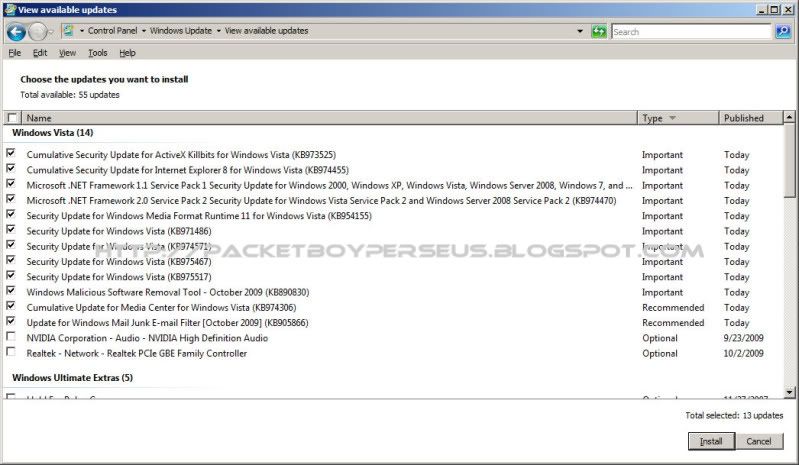
October 13, 12 Updates for my Vista box, 1 Goal: Security


I would like to thank Dungeons & Dragons Online MMORPG for giving me a reason to play around with my Lenovo SL300 again and at the same time discover the multiple security updates for Vista released today by Microsoft.

This laptop has been sitting around gathering dust for a while. Simply because I hated the bundled Windows Vista Ultimate Sp2 OS. I would consider it a moderate-gaming laptop, with a dedicated Nvidia 128mb graphics chip. I rarely open this laptop, save for occasions where I need to do cross-Windows OS platform compatibility and User Acceptance Testing (UAT) of our proprietary VoIP application.

Another reason I boot it up is just to make the Avira Free Anti-Virus and Spybot S&D definitions updated, and of course, checking for Windows Updates is critical and has always been a routine for me every time I boot up my Windows systems, and any Windows systems I play around with regardless if I have it set to acquire Automatic Updates.

Today, October 13, after getting tired of completing Rank 2 Quests for my female Monk character (Yes, shame on me, my account in DDO is VIP) I decided to log out of my alternate universe, head back to the real world and work on my Security+ reviewers and SANS Institute Reading Room materials.

Jumping from one security website to another is a good alternative method to review. Sometimes staring and reading a book with 1000 pages will bore you one way or another, and you will want something more interactive.

One of the websites I frequently visit is Threatpost.com, a relatively new site which I find very enjoyable to read. Not 2600'ish, but the articles and pictures are very enticing. The white page background and colorful graphics on this website makes the hardcore articles look like easy-reading, hence the enticing factor.

Threatpost also scales well on my Blackberry 8330's screen; as well as this humble blog of yours truly. Please go and try it. I find it very convenient to just pop-out my smartphone and read along every time I ride the BART going to work. Keeps me updated on the current IT security news. It's like Slashdot but only with Security-related topics.

Back to my Vista Ultimate SP2 box and its merry 12 updates from Microsoft on a single day, here's a screen shot of the list (click on thumbnail to enlarge screen shot)


Just by looking at these KB numbers I am already having headaches :-) Head to Microsoft's Security Bulletin website to find out what each Knowledge Base (KB) is all about:
http://www.microsoft.com/technet/security/current.aspx

You may want to try and use Microsoft's Baseline Security Analyzer on a couple of your Vista boxes. Just to make sure your Vista boxes, your brother's, your sister's, even your friend's friends Vista boxes are updated and safe.

Vista is beyond SMBv2 exploit (MS0-9050) nowadays, it has been a haven of choice for wannabe hackers and script-kiddies.

I wonder what's going to happen with Vista with Windows 7 coming out in a few days. Will it be the new Windows ME in memory?

Play safe kids.
Ron


Wednesday, October 7, 2009

Poor City Planing and your Disaster Recovery Plans


T
he Philippine Government finally admitted that poor city planning was the root cause of the recent massive flooding claiming the lives of nearly 300 people near and around the City of Manila.

Growing up in the Philippines, it doesn't take a genius to figure this out. We do not need statistics or blueprints of how the city was designed to scale presented to us to understand this.

You see it and you smell it.

I hate to say the "smell" thing because its very unlikely to come out from a patriotic Filipino guy like me, but it is the truth at least in my experience and opinion. Some part of Metro Manila is so congested that you do not need to open your eyes to know that this area is overpopulated.

You can't blame those people. Healthy conditions are the least priority of people who rarely eat at least twice a day and needs a shelter at night. Celebrities and politicians residing in tall buildings were not spared as well by the flood. There was even a story circulating around of a "dashing" rescue, worthy of a movie, wherein a famous actor rescued an actress in distress from her tall residential building using a speedboat. And not helping the less-privileged neighbors.

In the corporate IT world, I can almost imagine the feeling of helplessness of the people in charge of the Disaster Recovery and Business Continuity Plans (DRP & BCP) for their respective organizations.

These guys, mostly the Senior Network Administrators and Chief Security Officers of the corporate world, spent hundreds of man-hours in designing, testing, and implementing plans to
disaster-proof their business, regardless if its a natural or man-made disaster. The basic and ultimate goal is to survive such events and still continue to do business.

The problem is the actual city where your network infrastructure and organization is physically located. If the city was not designed with security, room for growth, and disaster recovery in mind, your plans get tossed out of the window.

Major City planners of the world should take a page out of secure software developers book: Design with security in mind. And spend less time mitigating risks.

If your city gets flooded to the point that major streets and thoroughfares look like a wild, gushing river, your well-laid plans most likely will take a detour. This detour is where your plans will be actually tested because you do not know whats going to happen next.

However, on major events like this, disaster recovery and business continuity plans should be tossed out of the window for the time being and self-preservation and helping other lives should be the number one priority.

After securing the lives of people working for your organization, go out and help out. Events like this happen for a reason and it makes organizations and cities plan and prepare better for the future.

Lessons learned is always the last phase of such events. Take detailed notes, recall how the event escalated, and learn from your mistakes.

Monday, September 21, 2009

PDF Reader Risk Mitigation and Herd Mentality in IT Security Best Practice

The prevailing trend for security conscious system administrators and IT personnel nowadays regarding the risks that Adobe Acrobat PDF reader presents in the network is to dump the entire PDF reader application in favor of another.

This trend is an attempt to accomplish Risk Avoidance. Risk Avoidance is a Risk Management Method wherein you terminate the activity that is introducing the risk. In short, no need to implement and keep track of your Risk Mitigation process since there is nothing to keep track of in the first place. No Adobe PDF Reader, no risk. And why worry about Adobe PDF Reader Zero-Day exploits when you can use another PDF reader that is not affected by such vulnerabilities? Ok, that sounds logical and you may have a point Mr. IT Admin Sir, but please listen.

Enter Foxit PDF reader, the leading candidate and alternative for Adobe's dominant PDF Reader. However, converting your entire company to Foxit PDF reader does not guarantee 100% Risk Avoidance. The Top 2 misconceptions about Foxit PDF Reader are the following:

1. Foxit PDF Reader does not have Javascript (Who needs Javascript on a document reader anyways?!)

>False. Foxit PDF Reader (the most recent version in time of this writing is 3.1.1.0901) also has Javascript and as a matter of fact, is also enabled by default during first installation. So go ahead and disable that damn Javascript by going to Tools>Preferences>Javascript and remove the check mark to disable it.

2. Foxit PDF Reader doesn't have exploits and vulnerabilities like Adobe PDF Reader.

>False. Although Adobe PDF Reader leads in scoring when it comes to exploits and vulnerabilities (Like 10 Exploits Adobe PDF Reader, and 2 Exploits Foxit PDF Reader) Foxit has its own share of bad apples. From Buffer Overflow Exploit to Remote Denial of Service Exploit, yes, Foxit is also prone to PDF-related exploits and vulnerabilities.


It won't take long for malware authors and security researchers to create new and more exploits targeting alternative PDF readers such as Foxit PDF Reader. The same rule applies when dumping Adobe PDF Reader in favor of another; patch your applications and systems on a regular basis, keep tab of Zero-Day exploits. Enforce your company or organization Policies, Standards, Baselines, Guidelines and Procedures to the full extent but not to the point that you lose your sanity in the process, and your co-workers start tagging you as control freak.

Although I find random on-the-spot, casual conversation, Security Awareness Training the best tactic one can employ inside the workplace. So every morning, while lining up for coffee at the pantry room, go ahead and break some "cool" and "leet" IT security news to your fellow workers, they will enjoy it as long as you tell the story like how movies tell them. Avoid jargon and acronyms please and make it exciting. Think Quentin Tarantino directing a hacker-movie.

Bruce Schneier made an excellent point on his speech about "The Future of the Security Industry: IT is Rapidly Becoming a Commodity" on a recent OWASP Meet. Bruce mentioned that the trend nowadays with IT security is slowly turning into a somewhat herd mentality. They are doing it, so let's do it, that kind of thing. Even current Best Practices recommended by the community is suffering from such herd-mentality syndrome. I somehow agree on this notion since everywhere I go and every material I read describes a Best Practice guide which usually doesn't always apply to all.

We need to treat each system, no matter how closely it resembles other systems, as a unique system with a different set of variables and behavior. So please, stop treating those Best Practice Guides as your bible and study your network how it behaves.

Cheers!
Ron


Sources:
1. "Handling Risk" Page 107, Chapter 3: Information Security and Risk Management, All-in-One CISSP Exam Guide 4th Edition by Shon Harris, CISSP, MCSE
2. Bruce Schneier: The Future of the Security Industry: IT is Rapidly Becoming a Commodity, http://vimeo.com/groups/owaspmsp/videos/6495257
3. Open Web Application Security Project (OWASP), http://www.owasp.org/index.php/Main_Page
4. http://www.schneier.com/

Sunday, September 13, 2009

Steganography meets VoIP in hacker world


An excellent way to hide messages or malicious payloads, making use of the unused UDP-RTP bits on a voice stream. I bet I can see the malformed or modified part of the RTP stream on Wireshark! Back to the lab for some tests!

Complete details on the link below.

Steganography meets VoIP in hacker world
Posted using ShareThis

Have fun inserting stuff on those unused bits!
Ron

Wednesday, September 9, 2009

"Daemon" by Daniel Suarez.

A must-read for everyone interested in the future of AI, automation and technology in general.

This novel is awesome. All the enumeration, sniffing and penetration methods and tools used in the story are all real and up-to-date. A computer game software genius dies and leaves behind the best AI ever created and a kick-ass "daemon" process to automate things. How do you fight evil packets? Go figure it out how the rest of the story unfolds.

So for a change, get out of your chair, away from your computer monitor and pick up the book from the nearest bookstore t. Currently enjoying the Audio Book version for my second reading of the book, and drooling of having my hardcover copy signed by the author.


http://thedaemon.com/

Below is a brief E-mail exchange with the genius behind the book, Daniel Suarez:


Excellent novel Daniel, looking forward to Freedom (TM).

One question though, regarding this line from the novel:

"So far, Gragg had a cache of nearly two thousand high-­
net-­wort identities to sell on the global market, and the Brazilians and Filipinos
were snapping up everything he offered."

Does this mean that based on your research (and statistics), most of these bad guys lurking around IRC channels are either from Brazil or the Philippines?

I am a Filipino residing here in the Bay Area and I am into VoIP Security, and overall IP-based Systems Security as well.

All the best,
Ron

+++

Hi Ronald,


Thanks for the kind note. I'm glad you enjoyed Daemon.

When I wrote Daemon back in 2004, Brazil and the Philippines were big
centers for identity theft; however, much of that has since moved to other countries. With the rise of botnets, though, it's increasingly difficult to tell where exploits and penetrations originate (with zombies serving as proxies...).


Best,
D.S.

+++

Daniel,


Agreed, 2004, those where the days. Now the Philippines is into hosting Call Centers
(and exploiting them) and Brazil is into US-Satellite tapping, lol.


Do you mind if I post your reply to my blog? (http://packetboyperseus.blogspot.com) I am planning to put up a simple personal review so my network of friends can see it and eventually pick it up from the nearest bookstore. I am sure they will love it as well.

All the best,
Ron


Hi Ronald,

My main point is that the future of cyber warfare is going to be driven by botnets and
distributed attacks originating from small groups of individuals (not
nations).

I don't want to sound like I'm 'blaming' that on Russians,
Brazilians, or Filipinos. The root cause of our IT security problem is
the inherently open architecture of global networks and the monoculture
that is modern software.

There are now cyber criminals and cyber warfare
units all around the world, and solving the infrastructural issues is
more important than playing international whack-a-mole with would-be
perpetrators--no matter what country they hail from.

Best,
D.S.

+++

Saturday, September 5, 2009

Tracing packet drops in Florida and sniffing traffic from 35K feet

I recently traveled to Hollywood, Florida for a customer on-site network troubleshooting. We usually do things over the phone and remote access if needed, but this customer insists that its our VoIP application acting up, and not their network. So the next day I went to their facilities, met with one of their IT Staff and immediately started mapping out their wired network (for fun and profit).


After a couple of minutes of tracing un-labeled RJ45 cables and network devices in general, I was able to trace the root cause. The bottleneck is originating from a commercial firewall installed on their network. I am not going to identify the brand and model, but its one of those firewall not meant to handle tremendous amount of traffic. In short, its a small-office-home office firewall/router. Their facility generates around 12 to 20mbps of outbound traffic on a daily basis.

This firewall goes gaga when hit by too much traffic; it simply drops all concurrent connections and resets as evident on the firewall and router logs. Good thing their Network Admin made the right choice and decided to get hold of a Cisco ASA 5505 Security Appliance and replace their current firewall. The problem is this guy does not know how to configure the ASA and needs to outsource the configuration and installation, so the ASA needs to wait while the problem still persists on their converged network.

To add salt to the wound, they are using old-school workstations; running Celeron 2.0ghz processors with a measly 256mb of SDRAM. Understand that these workstations handle a softphone-based VoIP client, a web-based CRM, Instant Messaging client, and Agent productivity apps. I say good luck with that. As suspected, Agents usually encounter the white screen of death where everything halts and freezes, hitting the Reset button is their usual routine.

Add the workstation hardware issues and misconfiguration on the network and you get a very painful and regretful VoIP experience.

Knowing how painful this experience is to their Agents, what I did was strip down Windows XP Pro to the bare minimum to free additional memory and overall system resources. What I meant with a stripped-down version is by disabling all Local Services that are not needed, adjust the workstation to Best Performance, disable tons of start up and running applications via msconfig, and finally, lock down the Agent login to Limited Rights so they can't install those nasty shopping IE add-on toolbars, lol. Things you must do when no Domain Controller is not present on a large network.

O
n my way back home to the Bay Area, I had some fun on-flight thanks to Gogo In-flight Internet without actually signing up for their service.

Thanks to Wireshark, ZenMAP GUI, and my laptop's Intel(R) Wireless WiFi Link 5100 card I was able to take a glimpse of the WiFi activity on-board the plane.

Intense Scan plus UDP output on NMAP:
nmap -sS -sU -T4 -A -v -PE -PA21,23,80,3389 172.19.131.2

Starting Nmap 5.00 ( http://nmap.org ) at 2009-09-03 16:40 Pacific Daylight Time
NSE: Loaded 30 scripts for scanning.
Initiating ARP Ping Scan at 16:40
Scanning 172.19.131.2 [1 port]
Completed ARP Ping Scan at 16:40, 0.22s elapsed (1 total hosts)
Initiating Parallel DNS resolution of 1 host. at 16:40
Completed Parallel DNS resolution of 1 host. at 16:40, 11.39s elapsed
Initiating SYN Stealth Scan at 16:40
Scanning 172.19.131.2 [1000 ports]
Discovered open port 80/tcp on 172.19.131.2
Completed SYN Stealth Scan at 16:40, 5.05s elapsed (1000 total ports)
Initiating UDP Scan at 16:40
Scanning 172.19.131.2 [1000 ports]
Completed UDP Scan at 16:40, 4.26s elapsed (1000 total ports)
Initiating Service scan at 16:40
Scanning 1001 services on 172.19.131.2
Service scan Timing: About 0.40% done
Service scan Timing: About 1.50% done; ETC: 18:43 (2:00:31 remaining)
Service scan Timing: About 3.00% done; ETC: 18:13 (1:29:33 remaining)
Service scan Timing: About 4.50% done; ETC: 18:02 (1:18:15 remaining)
Service scan Timing: About 5.99% done; ETC: 17:57 (1:12:09 remaining)
Service scan Timing: About 7.49% done; ETC: 17:54 (1:08:07 remaining)
Service scan Timing: About 10.39% done; ETC: 17:43 (0:56:12 remaining)
Service scan Timing: About 10.49% done; ETC: 17:50 (1:02:43 remaining)
Service scan Timing: About 13.39% done; ETC: 17:43 (0:54:02 remaining)
Service scan Timing: About 13.49% done; ETC: 17:48 (0:58:55 remaining)
Service scan Timing: About 16.38% done; ETC: 17:43 (0:52:03 remaining)
Service scan Timing: About 16.48% done; ETC: 17:47 (0:55:49 remaining)
Service scan Timing: About 19.38% done; ETC: 17:42 (0:50:03 remaining)
Service scan Timing: About 19.48% done; ETC: 17:46 (0:53:11 remaining)
Service scan Timing: About 22.38% done; ETC: 17:42 (0:48:06 remaining)
Service scan Timing: About 28.37% done; ETC: 17:42 (0:44:16 remaining)
Service scan Timing: About 34.37% done; ETC: 17:42 (0:40:29 remaining)
Service scan Timing: About 40.36% done; ETC: 17:42 (0:36:45 remaining)
Service scan Timing: About 46.35% done; ETC: 17:42 (0:33:01 remaining)
Service scan Timing: About 52.35% done; ETC: 17:42 (0:29:19 remaining)
Service scan Timing: About 58.34% done; ETC: 17:42 (0:25:37 remaining)
Service scan Timing: About 64.34% done; ETC: 17:42 (0:21:55 remaining)
Service scan Timing: About 70.33% done; ETC: 17:42 (0:18:13 remaining)
Service scan Timing: About 76.32% done; ETC: 17:42 (0:14:32 remaining)
Service scan Timing: About 82.32% done; ETC: 17:42 (0:10:51 remaining)
Service scan Timing: About 88.31% done; ETC: 17:42 (0:07:10 remaining)
Service scan Timing: About 94.31% done; ETC: 17:42 (0:03:30 remaining)
Service scan Timing: About 98.90% done; ETC: 17:43 (0:00:41 remaining)
Completed Service scan at 17:42, 3688.53s elapsed (1001 services on 1 host)
Initiating OS detection (try #1) against 172.19.131.2
NSE: Script scanning 172.19.131.2.
NSE: Starting runlevel 1 scan
Initiating NSE at 17:42
Completed NSE at 17:43, 36.19s elapsed
NSE: Starting runlevel 2 scan
Initiating NSE at 17:43
Completed NSE at 17:43, 5.02s elapsed
NSE: Script Scanning completed.
Host 172.19.131.2 is up (0.0014s latency).
Interesting ports on 172.19.131.2:
Not shown: 1000 open|filtered ports, 999 filtered ports
PORT STATE SERVICE VERSION
80/tcp open http?
| html-title: Site doesn't have a title.
|_ Did not follow redirect to http://airborne.gogoinflight.com/abp/page/abpDefault.do?REP=127.0.0.1&AUTH=127.0.0.1&CLI=172.19.131.153&PORT=54273&RPORT=54272&acpu_redirect=true
MAC Address: 00:E0:4B:22:96:D9 (Jump Industrielle Computertechnik Gmbh)
Warning: OSScan results may be unreliable because we could not find at least 1 open and 1 closed port
Device type: general purpose
Running: Linux 2.6.X
OS details: Linux 2.6.18 - 2.6.27, Linux 2.6.26
Uptime guess: 0.405 days (since Thu Sep 03 07:59:45 2009)
Network Distance: 1 hop
TCP Sequence Prediction: Difficulty=197 (Good luck!)
IP ID Sequence Generation: All zeros

Host script results:
|_ nbstat: ERROR: Name query failed: TIMEOUT

Read data files from: C:\Program Files\Nmap
OS and Service detection performed. Please report any incorrect results at http://nmap.org/submit/ .
Nmap done: 1 IP address (1 host up) scanned in 3757.66 seconds
Raw packets sent: 4045 (148.498KB) | Rcvd: 31 (1502B)
Wireshark Capture Screenshot:


Noteworthy discovered Protocols and Services gathered from the Wireshark .pcap capture:

- Cisco IP-SLA
- TACACS and XTACACS
- BOOTP
- TFTP
- CLDAP (Connectionless Lightweight Directory Access Protocol)
- Cisco Wireless LAN Context Control Protocol
- Mobile IP Protocol (RFC 3344)
- RIP (Routing Information Protocol)
- OpenVPN
- OCSP (Online Certificate Status Protocol)
- Slimp3 Communication Protocol (Device ID: 101) (Firmware Revision: 6:12 (0x6c)
- Base Station Subsystem GPRS Protocol (BSSGP)
- CFLOW (Cisco NetFlow/IPFIX)
- CUPS (Common Unix Printing System)
- GPRS Tunneling Protocol (GTP)
- H.225.0 RAS

Discovered Network Device Signatures/MAC OUI's:

- JUMP INDUSTRIELLE COMPUTERTECHNIK GmbH (00:e0:4b)
- Hon Hai Precision Ind. Co., Ltd. (00:22:69)

You can easily Google those two identified manufacturers and you will have and idea what type of devices they produce.

As always, hit me up on E-mail if you want a copy of the complete .pcap capture and I will be glad to send you a copy, for research and analysis of course. Let me know if you guys need additional information as well about my recent 35K feet packet-sniffing adventure.

On my next flight, I am bringing an external USB antenna with packet-injection capability :-) attached to my future 1000HE netbook.

Happy packet-sniffing everyone and try not to break any law in the process!
Ron

A playground for network security enthusiasts, innovators and early adoptors


Welcome to my blog, this is me thinking out loud about Voice over IP security (VoIP), managing and optimizing converged networks, Metasploit Framework, Cloud Computing, general security and privacy concerns, grappling adventures, and tuning my MKIV VW Jetta.

All inputs, feedbacks and violent reactions are welcome.

Packet Boy Perseus
Helping spread a positive image why we hack things.

About Me

I am an InfoSec Innovator, a Blue Ocean Seafarer and a Paul Graham Pupil.